


A market on the move - and a market with a motive
The over-60s in the UK are sitting on £3.84 trillion of housing wealth, according to research published by Savills in early 2026. That is more than the entire annual output of the UK economy - concentrated in the hands of one generation, tied up in bricks and mortar, and currently generating almost no economic activity.
You can understand why that number catches people's attention.
The equity release market lent £2.57 billion in 2025, up 11% on the year before - and the industry expects that growth to continue. But this is about more than market momentum. In early 2025, the government introduced a framework called "targeted support," giving financial firms permission to approach whole categories of customers with marketing for products like equity release, without owing any individual a duty of care. Shortly after, the Financial Conduct Authority publicly positioned later life lending as a new pillar of retirement income, lending official weight to the idea that borrowing against your home is a normal, sensible part of planning for life after work.
Much of that £3.84 trillion will pass to the next generation eventually. But governments and economies run on activity now, not on inheritance tax receipts in 20 years' time. Getting some of that wealth moving is attractive to providers, advisers, and the Treasury alike.
None of that means equity release is wrong for you. For some people, in the right circumstances, it genuinely is the right answer. But when powerful commercial and political incentives all point in the same direction, it is worth making sure you understand what you are being pointed towards.

What you are actually signing up for
The overwhelming majority of equity release products are lifetime mortgages. You borrow a sum against your home - either as a lump sum or in stages - and pay nothing back each month. Instead, the interest compounds and is settled, along with the original loan, when you die or move into long-term care.
The compounding is the part that catches people out.
Lifestyle-first Retirement Planning — Download the Free RetirePlan UK App
Available on iOS, Android, and web — or visit retireplan.co.uk



The average APR on equity release products was around 7.24% in mid-2025. Because interest compounds over time, the total amount owed grows faster than many borrowers initially appreciate - the longer the plan runs, the more pronounced that effect becomes. A plan taken at 60 could easily run for 25 or 30 years, which is a very long time for compound interest to do its work. Even after 10 years, the amount owed could be almost twice the initial borrowing.
It also helps to understand how the advice is paid for. Equity release advisers earn a fee from you, typically calculated as a percentage of the amount borrowed, plus a commission from the lender. Both must be disclosed, but the combined effect is that advisers have a commercial interest in you proceeding - and in borrowing more rather than less. That is not a criticism of any individual adviser. It is simply the structure of the market, and it is worth knowing before you sit down at the table.
When it makes sense - and what else is worth considering first
It would be unfair to write equity release off entirely. Product standards have improved significantly over the past decade. Plans that meet Equity Release Council standards come with a no negative equity guarantee, fixed or capped rates for life, the right to make voluntary repayments, and secure tenure for life. Many modern plans allow you to make interest payments as you go, which controls how fast the debt grows and changes the long-term cost considerably.
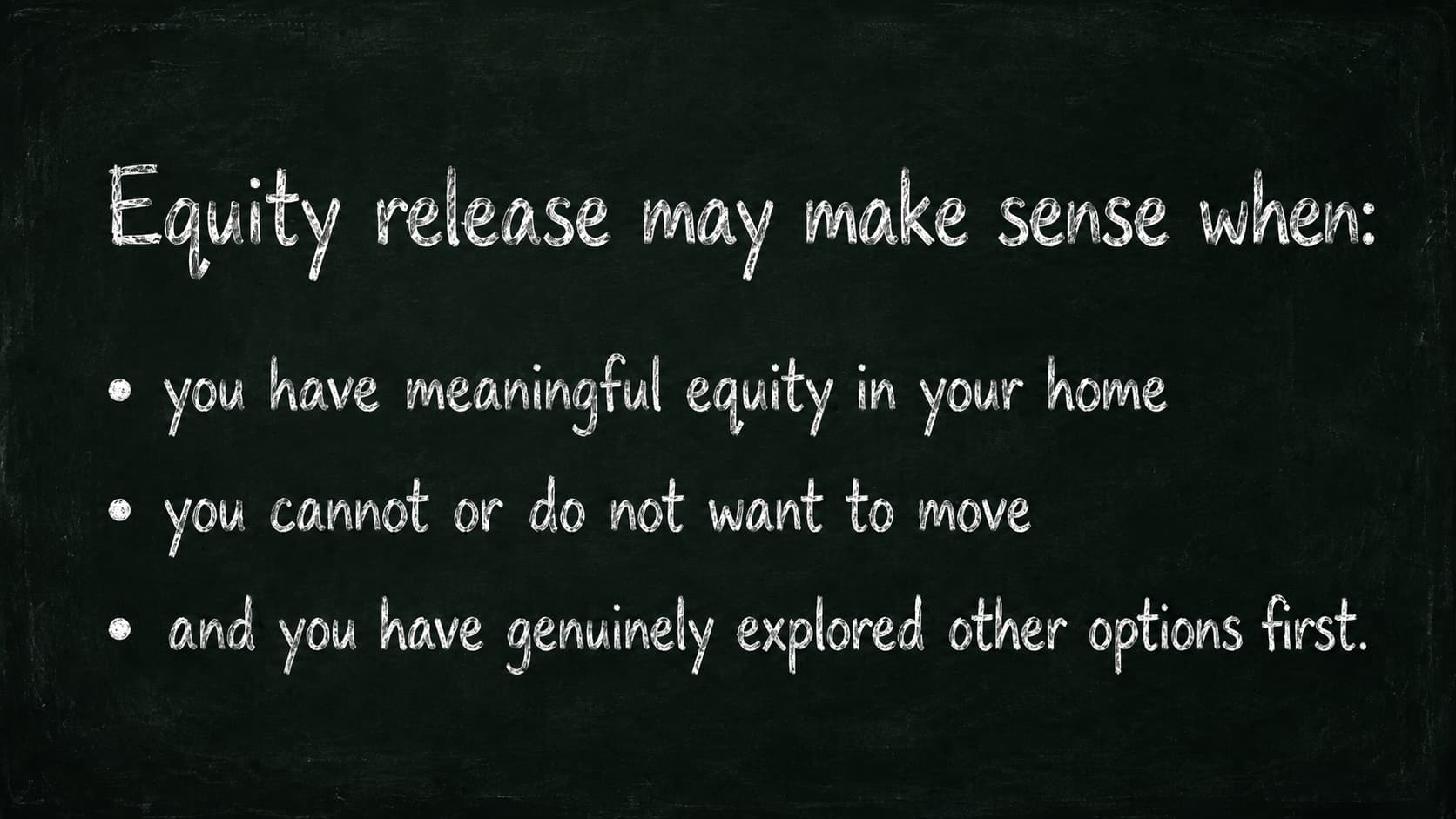
Equity release tends to make most sense when the following three things are true:
- you have meaningful equity in your home
- you cannot or do not want to move
- and you have genuinely explored other options first.
That last point matters. Before borrowing against your home, it is worth asking whether downsizing could achieve the same outcome without taking on debt at all. Moving to a smaller property can release capital outright, cut running costs, and - done thoughtfully - open up a new chapter that suits your life better than the family home you no longer need. It is not the right choice for everyone, but it deserves a proper look before a lifetime mortgage enters the conversation. We will cover downsizing in detail in a forthcoming RetirePlan blog post.
For those who cannot or genuinely do not want to move, a carefully structured lifetime mortgage, taken with independent advice, can be a practical route to a better quality of life. Just go in with realistic expectations about the long-term cost.
Start with what you already have
The most useful thing you can do before anyone raises the subject of equity release is get a clear picture of what your retirement income will actually be. State Pension, workplace pensions, private savings, any other income sources - the full picture. People are often surprised by how much more reassuring that total is than the vague anxiety they had been carrying around.
Almost four in ten future retirees are on track for a retirement income below the minimum standard identified by Pensions UK - which tells you the need is real for some people. But "some" is not "most," and the targeted marketing that is now arriving will not make that distinction on your behalf. LV=
If, once you have a clear income picture, there is still a gap worth filling, equity release may genuinely be worth exploring. Look for advice from someone whose first question is whether you actually need to borrow against your home at all. Read the long-term cost projections carefully, not just the headline figure. And consider every alternative first - including whether a different home might suit your next chapter better than your current one.
The RetirePlan Finance Planner is built for exactly this moment. It brings together your pensions, savings, State Pension, and other income to build a personalised projection - so you can see clearly, in plain English, what your financial position actually looks like before you make any significant decisions about your home.
Ready to see what your retirement income really looks like? Download the free RetirePlan UK app on iOS and Android, or start your plan at app.retireplan.co.uk.
REFERENCES & RELATED READING:
- Savills: £3.84 trillion of housing wealth held by the over-60s (March 2026): https://www.savills.co.uk/insight-and-opinion/savills-news/389617
- Equity Release Council quarterly market data: https://www.equityreleasecouncil.com/news_type/market-research-data/
- RetirePlan blog: Is Downsizing Right for You? [forthcoming - internal link to be added on publication]
- RetirePlan blog: How Much Income Do I need In Retirement? [internal link to be added on publication]